Most "AI comic" demos stop at one pretty image. The hard part was never the image — it's episode 47.
Last month I finished The 101st Regression, a 60-episode regression-fantasy webtoon, as a one-person studio. Every panel, every speech bubble, every episode was produced through the AI pipeline we're building at owntent. You can read the first episodes free at owntent.com/watch/regret101.
This post is about what actually breaks when you scale from one image to a series, and what we had to build to fix it.
The real problem is consistency, not quality
A single AI image can look great. Forty panels of the same protagonist is a different sport: image models will happily reinvent your character's face, outfit, and hair every single generation.
The fix that worked was boring and structural: lock a character sheet first, then never generate without it. Before any episode work, each cast member gets a multi-angle reference sheet — front, three-quarter, side, back, plus expressions — generated once and saved as the single source of truth. Every panel generation afterwards receives that sheet as a reference image, along with tokenized appearance notes (hair, eyes, outfit, distinguishing marks) baked into the prompt.
Without the sheet: a different person every panel. With it: the same face for 60 episodes.
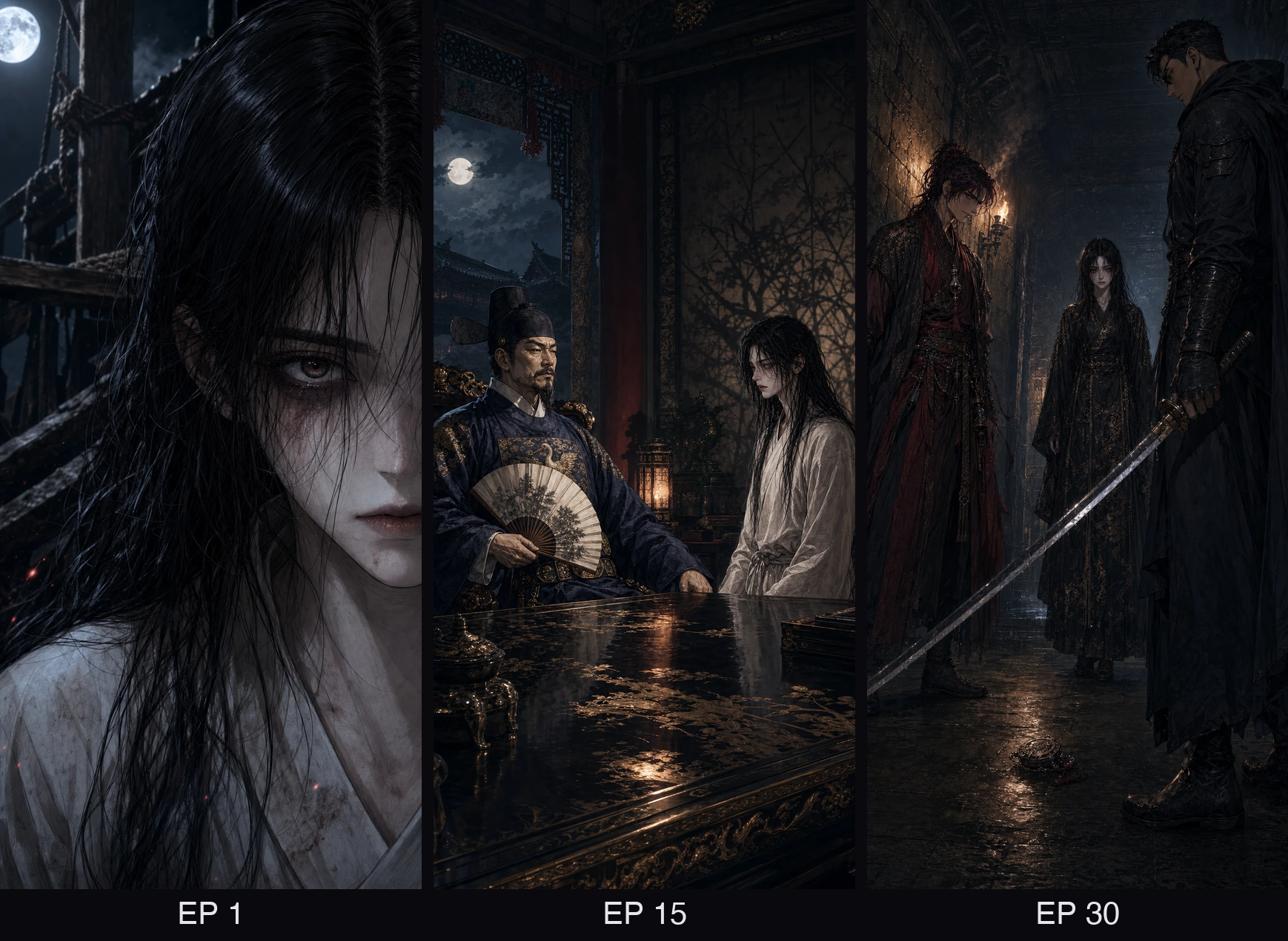
A webtoon episode is ~40 cuts, and pacing is a spec
An episode is not "some images in a row." Ours ran around 40 panels each, and the vertical-scroll rhythm — wide establishing panel, tight reaction, beat of empty space before the cliffhanger — is a spec the pipeline enforces, not a vibe.
We wrote the episode as a beat sheet first (hook, escalation, twist, cliffhanger), broke it into a numbered shot list with camera notes, and only then generated panels. When a panel failed review — wrong location, broken hands, unreadable dialogue — it went back with specific fix instructions, not a blind re-roll.
Speech bubbles are part of the image
We render dialogue into the panels rather than overlaying text afterwards. That means the prompt carries the bubble type (speech, thought, shout, narration) and the exact line. It forces the layout to respect the text and keeps the reading flow native. The trade-off: a typo means a re-render, so the script gets locked before art starts — which is how real studios work anyway.
Batch production is where AI actually pays off
Episodes 2 through 60 were produced as batches: the pipeline walks the episode map, renders panels in parallel, validates each one against the reference sheets, and re-generates the failures. My job shifted from "making images" to reviewing dailies and rejecting bad takes — a director's job, not an illustrator's.
That's the entire thesis of owntent: AI doesn't replace the author. It replaces the production line under the author, and hands one person the leverage of a studio.
What's next
The same pipeline now runs short-form drama (script → casting → shots → voice → edit), and both formats publish to the same reader where creators keep their audience relationship — follows, memberships, and credits, without an algorithm in between.
Read the result first, then judge the pipeline: The 101st Regression, first episodes free. If you want to direct your own, start at owntent.com.